

Written by Graham Patterson - Principal Consultant at Gemserv
ARE WE READY FOR DIGITAL TRANSFORMATION?
INTRODUCTION
In 2016 Harvard Business Review reported failure rates for Digital Transformation at running between 66% and 84%[1]. These rates are generally accepted and often quoted regarding Digital Transformation and the approach to take. Failure to effectively implement a transformation programme is not new following the advent of digitally driven change, it has happened before with technology driven change, computerisation, and, we suspect, even the introduction of the steam engine.
What does the term Digital Transformation actually mean? The development of the Internet started to change how business was conducted and this accelerated into the consumer market when Apple introduced the first covetable smart phone. Since then the consumer market has been driving the way that businesses work. Services that are always on, and always available through a device that everyone carries, has become the norm. This has changed not just the technology, but the way services are delivered. High speed internet has made the move from ownership to subscription for music, films and books viable, and they have now become the standard ways of consumption, across many different channels, from traditional downloads onto computers, through smart phones and increasing through smart home devices such as Alexa.
In working with Governments and commercial organisations, both large and small, we have seen Digital Transformation programmes that have succeeded in part, or in whole, and ones that have stalled almost before they started. The scope has ranged from the small company dabbling in new technologies, to government departments trying to completely change the way they interact with citizens.
The more successful programmes we have experience of, tend to have some common factors:
• The transformation is driven from the top with a clear, articulated strategy of where the organisation wants to be, with digital seen as a key factor in the services being delivered. This strategy needs to be updated and reviewed but still pursued with energy.
• Digital is part of the normal mode of operation for the organisation, not just for customer services but also for internal operation. The best digital practices, not just digital technology, is seen as a standard way of working and employees are encouraged to learn and try using the tools and methods. Google is known for allowing its engineers to spend 20% of their time on side projects. This improves skills, encourages innovative thinking, and has previously delivered services such as Gmail and Google Maps.
• There is a relentless focus on understanding the customer, using data to uncover new information and test assumptions. The whole customer experience is driven making it easier for the customer and stopping them going elsewhere to look at competitors services. Amazon ask for feedback on everything from the web site to the delivery of an item. This information is used together with information about orders, what you look at, and analysis of others with a similar demographic to provide a personalised interface.
Fig [1]... 7 questions to ask before your next Digital Transformation
OUR SURVEY RESULTS
At the Infosecurity Europe 2019 conference we conducted a survey about the current state of readiness for Digital Transformation across industries. The results showed significant differences in how companies are approaching Digital Transformation, how they see it as part of their service and how they are changing internally for the challenges ahead.
We split the questions into the three categories identified below:
- How the organisation and its leaders see digital as fundamental to success,
- How much the attitude to customers and development has been influenced by digital thinking, and;
- How much digital influences the way that the organisation attracts, trains and retains staff.
Needless to say, the responses differed in terms of maturity but also in terms of how holistic the approach was across single organisations.
1. DOES THE ORGANISATION AND ITS LEADERS SEE DIGITAL AS FUNDAMENTAL TO SUCCESS?
The move to digital ways of working is happening at an increasing pace and it is no longer enough to see it as a bolt on or nice to have. It needs to be considered at all levels in the organisation strategy. This is as true for a local hairdressers where appointments, reminders and discounts are through the customers phone, as it is for large insurance firms where personalised calculations of premiums are carried out using the latest demographic and lifestyle information about the customer. To assess this area, we asked about how much the strategy relied on digital and how data collected influenced the way the organisation worked.
QUESTION – HOW MUCH OF YOUR BUSINESS STRATEGY RELIES ON DIGITAL?
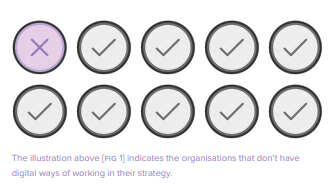
The majority of the organisations responding see digital ways of working as key to the realisation of their business strategy with under 10% having no mention of digital ways of working in their strategy.
If the benefits from digital working are to be realised, they need to be core to the way the organisation thinks, they need to be recognised within the business strategy, and adopted at senior management levels. This is true across a variety of industries. The speedy and intelligent use of data inherent in a digital approach is essential to any industry where customers have a choice on who to buy from. Once efficiencies have been achieved, using data analysis to differentiate should be core to any business strategy. This requires an understanding of the potential benefits and limitations of digital working by company leadership and direction within the business strategy.
We would recommend that a business strategy not only acknowledges digital but identifies how the organisation will exploit the digital way of thinking. This frequently requires a change in culture to gain company wide acceptance and having teams, like ours, that are experienced in the necessary change can help to lead by example, as well as act as player coaches for internal leadership.
QUESTION - HOW ARE INNOVATIVE IDEAS ADOPTED BY YOUR ORGANISATION?
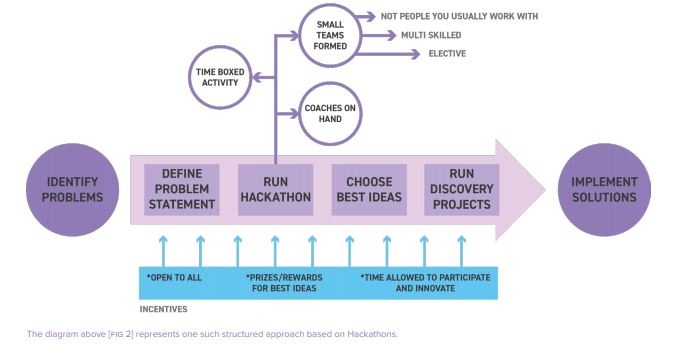
Over half of the organisations that responded are currently developing infrastructure that enables staff to explore innovation with under 20% having no infrastructure to enable staff to try new things recognising that many initiatives may fail.
Humans are curious by nature and the desire to experiment and explore is part of our DNA. Organisations need to maintain the same desire to find new, and profitable, ways of doing business. When organisations are very process driven and slow to adopt innovation, they find it hard to move to digital ways of working and can easily miss chances to improve service and profits. Having a structured way of analysing and, where possible, adopting new ideas makes the organisation more flexible and adaptable to change. Providing the analysis in a way that ensures early rejection of unsuitable ideas is a positive benefit to the cost controls of the organisation. Innovation failures need to be treated as a learning process and stored in the corporate memory since often the reason for failure is one of timing rather than the core idea. Innovative ideas should be re-evaluated regularly, avoiding the ‘we’ve tried it before’ mindset.
We would recommend a structured approach to allowing new things to be tried within the organisation. The organisation needs to be able to assess ideas quickly and concentrate on business benefits while learning from failures.
QUESTION - TO WHAT EXTENT DOES DATA INFLUENCE DECISION MAKING IN YOUR ORGANISATION?
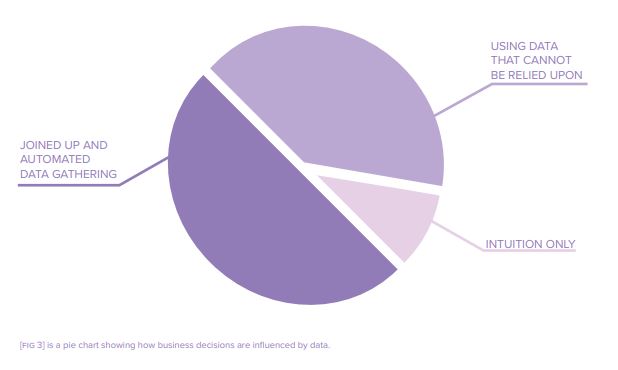
Half of the organisations responding are using joined up and automated data gathering to enable business decisions with quantifiable improvements in operational performance.
Use of data is a key fundamental for any sort of Digital Transformation. However, the ability to realise strategic advantage is dependent on having a strategic approach to the collection, validation and use of data collected. Recent data privacy regulations make it even more important that an understanding of what data is held, and how it can be used, exists. This is best held as a data strategy. The strategy needs to address data from multiple sources and can include data that is freely available from reliable sources as well as data generated inside the organisation. Data can provide insight to the working of an organisation as well as helping to provide better customer service. Saving in the streamlining of internal processes can be used to improve the resource available for customers.
We would recommend developing a data strategy to cover the data held, how it will and can be used and the way it relates to data from other sources. Any gaps can be identified and finding ways to close them suggested.
QUESTION - HOW IS NEW TECHNOLOGY DELIVERY AND EXISTING TECHNOLOGY MANAGEMENT GOVERNED IN YOUR ORGANISATION?
The majority of organisations that responded have moved beyond having technology governance limited to IT support. Though many report they have good technology governance almost half of the total still feel that there does not seem to be priority on moving away from legacy systems. Legacy systems provide a comfort blanket of a way of working that is know but they also frequently lock up the customer data in a way that makes it difficult to get real insight into what is happening. Reluctance to move away from them can constrain digital ways of working to fringe area, missing the real core of business transformation. How much is your attitude to customers being influenced by digital thinking?
In just over ten years the use of mobile phones and tablets have revolutionised the way that organisations interact with customers. The use of the personal digital device has led paradoxically to greater standardisation and greater personalisation at the same time. Ordering and paying for things from our phone has become a standardised way of living. At the same time, we expect to be able to track where our orders are, get personalised recommendations, and be remembered for what we have ordered before.
To achieve the sort of interaction requires a significant effort in understanding the customer needs together with analysing the data that is available about the customer and their interactions. To understand where organisations were on this part of the digital journey, we asked the three questions, which can be found in section 2.
2. HOW MUCH IS YOUR ATTITUDE TO CUSTOMERS INFLUENCED BY DIGITAL THINKING?
QUESTION - HOW DO YOU MEASURE CUSTOMER EXPERIENCE?
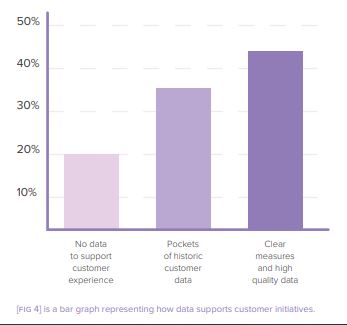
Almost 20% of the responses said there was no data to support customer experience initiatives while just over 40% reported clear measures.
Irrespective of how good the strategy alignment to digital is, the need for data to be able to deliver a good experience is vital. The benefits of a good customer experience are difficult to overestimate. In a competitive market making the interaction easy for the customer encourages reuse of the service. Even where there is no alternative, such as many Government services, making the interface easy to use and intuitive reduces errors, phone calls, and delay. That makes the service cheaper to run.
Improving the experience needs data and measurement. What might seem obvious to the organisation can be confusing to customers. It has become almost impossible to buy anything without being asked to rate the service and though that type of feedback is valuable there are other less subjective measures that can be used. These include such things as analytics on abandoned visits.
We would always recommend that how you are going to measure customer experience be a part of any digital initiative. For example, this may be through surveys and questionnaires, but also might using the data generated as a result of a customer using a service, such as how many customers started an interaction but didn’t complete it, how long they spend in different parts of the service offering, and how many return to use the service again.
QUESTION - HOW WELL ARE NEW INITIATIVES END-TO-END TESTED, BOTH THE BUSINESS PROCESS AS WELL AS ANY TECHNOLOGY?
From the survey it would appear that about half of organisations rely on the final testing of a service before they make sure the supporting processes are working. This can lead to having to patch together processes at the last minute, resulting in extra work and stress for staff and variable service for customers.
It is easy to think of the customer experience as being the web site or the app. That is only the front door, what the customer really wants is to have some service or goods delivered. The whole experience of getting a new car can be ruined by constant delays to delivery or the car having the wrong extras.
The whole process from first contact to service delivery and follow up needs to be designed, developed, and tested when putting digital services in place. If there are gaps, they can be closed before the service is launched and customers notice them. This is not normally as onerous as it sounds since most organisation will have standard processes for such things as complaint handling, customer queries, and service faults. However, how these operate needs to be checked to ensure they have the correct information and know what to do.
We recommend that testing should include the whole end-to-end service and should be tested from the start of development. Incremental testing as the service is developed follows the accepted best practice for agile development of software. By extending this to cover the full end-to-end service, we can ensure that the important areas of customer service readiness and ability to carry out the necessary support are covered.
QUESTION - HOW DOES YOUR ORGANISATION GO ABOUT ADOPTING NEW TECHNOLOGIES?
Encouragingly over a third of those that answered the question are adopting new technologies in line with strategic direction. However, almost half the respondents to the survey are adopting new technologies in places but without any alignment to the overall strategy.
It is important that customer needs are considered when adopting new technologies and they are seen as driving the strategy forward. This is not to confuse adoption of new technologies with the freedom to experiment and test new approaches and new technologies so that the value for money can be assessed. Now, more than ever, we are awash with new terms, new ideas, and views on what the latest must have technology is. Initially, many of these are niche products that are looking for a wider market. One such example is Blockchain, which started as a way of monitoring cryptocurrency and has taken some time to find uses in other areas such as pharmaceutical tracking. Jumping into the latest new technology without knowing if it delivers customer value and will drive customer adoption can result in high spending without the necessary return on investment.
We recommend that before adoption any new technology is tested not just against its capability but also against how it drives the organisations strategy forward through better customer experience. The way that customer experience is tested can vary, many organisations use specialist labs to study the way the service is used, others, such as Google, use large scale AB testing where a subset of users are directed to the changed experience to gauge reaction. In either case the way that the service is related to the organisation strategy is for the implementor to assess.
3. HOW DOES DIGITAL INFLUENCE THE ORGANISATIONS ATTITUDE TO STAFF?
QUESTION - HOW EFFECTIVE IS YOUR ORGANISATION AT ATTRACTING PEOPLE WITH DIGITAL SKILLS?
As in the wider business environment most organisations responding said they struggled to attract digital skills with over 50% acknowledging key posts being left vacant.
Finding and retaining skilled workers has become harder over the past year and ‘Many (68%) employers found that they were unable to find candidates who were suitable for vacant roles. Within the digital sector this skills shortage is considered even more acute. Though rewards are an important part of attracting good staff the prospects of interesting and socially rewarding work are also important to Millennials, the main source of digital skills. Working in cross functional teams with encouragement to look at new areas and acquire new skills will assist with recruitment. Amongst the other options is the promotion of more partnerships with specialist organisations and development of staff internally.
We would recommend consideration of options around flexibility of working and partner organisations as well as pure rewards when looking to fill digital vacancies.

QUESTION - HOW MUCH DOES YOUR ORGANISATION PROMOTE CONTINUOUS LEARNING?
Almost 65% of the organisations that responded reported a positive approach with colleagues continually improving their skills.
Continual learning is an important part of developing digital capabilities. As well as providing an environment for innovation as staff become used to learning new ways of approaching problems it also helps to provide a more interesting workplace. The questions above identified a shortage of digital skills in the job market and promoting continual learning makes it easier for internal staff to develop the skills necessary to fill the gaps without the need to recruit externally.
We would recommend considering a fixed allocation of staff time to learning, with each member having to show their colleagues something interesting that results from any investigation.

CONCLUSIONS
The overall results from the Digital Transformation readiness survey that Gemserv conducted showed that while there was a general awareness of the requirements for digital, the degree to which organisations have taken the necessary steps to successfully implement digital initiatives varies considerably. Encouragingly, the majority of organisations have realised the importance of building around customer needs and using data to deliver targeted improvements. There is even a recognition of the need to align business strategy with digital ambitions.
While there is work happening on the development of digital skills internally, there seems to be less priority on some of the digital approaches to delivery such as cross-functional teams and continuous change, which limits the effectiveness of some elements of digital transformation.
One of our key learnings from dealing with many clients, is that no two digital journeys are the same. The results in this survey serves to reinforce that point. Some may try and emulate initiatives implemented by competitors, or by other public sector bodies, but invariably differences in culture, competencies, technologies, and the way in which a business is structured means that these quickly begin to diverge from what may have been done before.
Also, Gemserv works across sectors where we see examples of good practice which are transferable. These may not be immediately evident to organisations looking to others within their sector for inspiration.
For each of the responses in our survey, we have made recommendations. If these resonate with you and you recognise your organisation in some of these situations, or if you think a course of action may be relevant to you but you are unsure what to do next, we would be happy to explore with you how you can tailor these findings to your own unique circumstances.
One of our key learnings from dealing with many clients, is that no two digital journeys are the same
....How does your journey start?
Created by Gemserv