

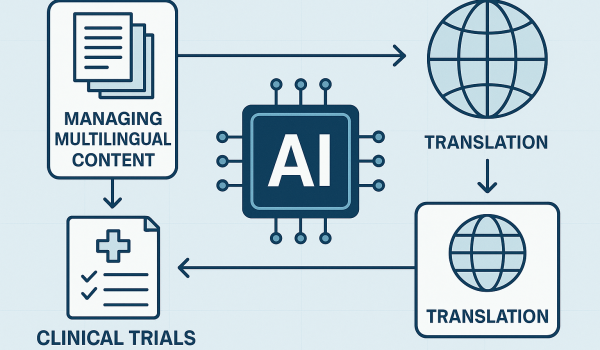
Managing Multilingual Clinical Trial Content with AI: A Fireside Chat with RWS and AWS
In a recent webinar hosted by the Executive Leaders Network, Peter Dorrington facilitated a discussion featuring Dan Herron, Vice President of Digital Health at RWS, and Arun Nallathambi, Senior Partner Solutions Architect at AWS. The session focused on the complexities of managing multilingual marketing, clinical, and regulatory documents in the life sciences sector—and how technology can support operational transformation.
Speakers
- Peter Dorrington – Moderator, Executive Leaders Network
- Dan Herron – VP of Digital Health, RWS
- Arun Nallathambi – Senior Partner Solutions Architect, AWS
Context: Clinical Trials Under Pressure
Dan Herron opened with an overview of key industry pressures. Clinical trials are facing staff shortages, with a 30% turnover among clinical research associates and cancer centres operating at just 35% capacity. Compounding this is declining public funding and regulatory complexity, all while demand for multilingual content continues to surge. These challenges require more than incremental fixes—they demand systemic change.
The Five Core Challenges
- Efficiency: Teams are overstretched. Staff turnover and shortages are impeding timelines and productivity.
- Content Explosion: Clinical content volume is increasing, especially with global trials demanding multilingual localisation.
- Costs: Post-pandemic budget tightening has squeezed margins and increased pressure on ROI.
- Time-to-Market: Speed remains critical. Delays in approvals or translations directly impact profitability.
- Compliance, Security, and Innovation: High standards remain non-negotiable—even as teams are asked to do more with less.
Technology’s Role in Meeting Clinical Content Demands
AWS Perspective: The Challenge of Global Coordination
Arun highlighted that clinical trials are burdened by fragmented systems, siloed data, and complex multilingual compliance requirements. From AWS's viewpoint, two challenges stand out:
- Patient Safety and Compliance: Navigating international data regulations and privacy laws requires precision and vigilance.
- Operational Inefficiency: Delayed processes due to legacy systems hinder the ability to deliver new therapies promptly.
The Solution: AI and Cloud Infrastructure
AWS is helping customers by integrating cloud infrastructure with AI-powered automation. Key benefits include:
- Aggregating and analysing data from multiple sources in real-time.
- Automating repetitive tasks such as document translation and terminology management.
- Supporting cross-border collaboration through secure, scalable global infrastructure.
Is Generative AI the Silver Bullet?
Both Arun and Dan caution against treating generative AI as a magic solution. Instead, they advocate for careful, phased adoption with strong human oversight.
Dan discussed RWS’s practical approach, which combines AI with human validation to maintain quality. Structured content authoring, machine translation (with human post-editing), and end-to-end integrated workflows have already achieved efficiency gains of up to 65%.
Arun echoed the need for rigorous validation layers—automated quality scoring, human review, and compliance frameworks—to ensure AI-generated content meets regulatory and safety standards.
Selecting the Right Technology Partner
The conversation moved to a key operational challenge: choosing the right tools. Arun stressed that off-the-shelf solutions are rarely effective in the life sciences context. Instead, organisations should prioritise:
- Domain-specific technologies designed for healthcare.
- Partners with proven track records in compliance and data protection.
- Flexible ecosystems that can scale and integrate seamlessly with existing infrastructure.
RWS and AWS: A Strategic Partnership
Dan outlined how RWS’s multilingual content management and translation technologies are natively built on AWS Cloud. This synergy allows life sciences clients to:
- Leverage AWS’s NLP tools (such as Amazon Bedrock) to extract insights from massive clinical datasets.
- Accelerate document processing using machine translation, memory, and terminology management systems.
- Ensure compliance by localising translation models and respecting data residency requirements (especially critical in Europe).
AWS enables this through scalable infrastructure, over 93 security certifications, and services like Health Scribe and Omics data storage that are tailored to regulated environments.
Impact on Patient Communication
The webinar closed with a discussion on how AI is starting to affect direct patient interactions. Dan noted that while humans remain essential—especially for sensitive communications—AI chatbots and translation tools are already helping patients understand trial documentation more clearly and in their native language.
Arun added that future capabilities may include AI-powered diagnostics assistants that interpret medical reports and deliver culturally nuanced, understandable information to patients—though privacy and trust will remain critical hurdles.
Key Takeaways
- Translation at Scale: AI-powered translation, validated by human experts, is essential for regulatory accuracy and speed.
- No Single Solution: Integration and flexibility are key—organisations must avoid over-reliance on generic platforms.
- Data Privacy First: Compliance, especially around localisation and data sovereignty, must be built into AI workflows.
- Partnership Matters: A successful transformation hinges on technology partners who understand sector-specific demands.
- Quick Wins First: Begin with high-feasibility use cases before scaling up AI deployment across the organisation.
Watch the Webinar On-Demand
To explore these insights in detail and access further practical examples, watch the full on-demand webinar here: 👉 Watch Now
Q&A Highlights
Q: How is AI validated for clinical translations?
A: Through a multi-layer validation process including automated quality metrics (e.g. BLEU scores) and expert human review.
Q: Can AI fully automate regulatory translations?
A: No. AI can accelerate the process, but human oversight is necessary for safety-critical and regulatory accuracy.
Q: How can organisations select the right AI tools?
A: Choose partners with healthcare expertise, data compliance capabilities, and tools designed for regulated workflows.
Q: What’s the future of AI in patient communication?
A: AI chatbots and assistants may offer basic diagnostics and 24/7 access to information, but trust, empathy, and transparency must be maintained.
#MultilingualClinicalContent #GenerativeAI #LifeSciencesTranslation #RegulatoryComplianceAI #AWSHealthcare #RWSDigitalHealth #AIinClinicalTrials #ContentLocalisation #TranslationManagement #ClinicalTrialInnovation
Recent Articles
A Balancing Act: Drive Sustainability while Managing Cost and Risk
April 27, 2023 by Vishal Patel - Ivalua
Let’s Get Digital: Introducing your Source-to-Pay Guide
March 9, 2023 by Vishal Patel - Ivalua