

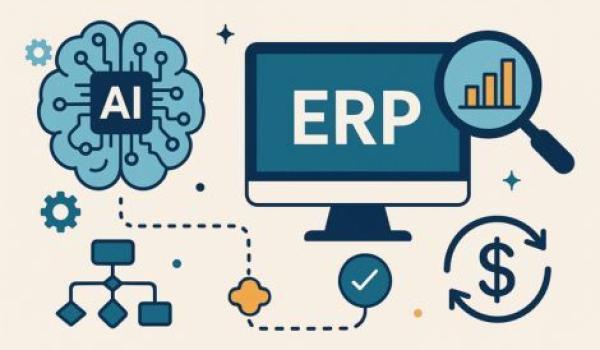
Transforming Business Operations with AI and ERP Integration
As artificial intelligence continues to reshape industries, organisations are being challenged to move beyond experimentation and towards strategic, scalable implementation. A recent webinar hosted by ELN in partnership with Priority Software explored how AI is being embedded into ERP systems, driving measurable efficiency and data-driven transformation.
The speakers at the event were:
- Eyal Katz, VP of Innovation, Priority Software
- Marijke Vanbergen, ERP Specialist, Priority Software Belgium
- Pieter De Buysser, Founder, NXTGN
- Karen Packham, Host/Moderator
AI Adoption: The Reality vs Expectation Divide
Despite AI’s widespread personal use, many businesses are still struggling to turn early adoption into organisational value. While individuals report time-saving benefits, enterprises often see little measurable ROI due to poor strategic alignment.
To achieve meaningful outcomes, AI must be integrated into an organisation’s strategy, culture and workflows bridging the gap between isolated experimentation and systemic change.
Embedding AI in ERP for Real Outcomes
Modern ERP systems now serve as the foundation for enterprise-wide AI integration. From intelligent forecasting and supply chain optimisation to natural-language search and workflow automation, ERP platforms are evolving into AI-driven environments that empower users through conversational and predictive capabilities.
AI features such as natural-language queries, automated report generation and forecasting algorithms enable smarter decision-making. Knowledge-graph architectures further improve accuracy by mapping data relationships between entities such as invoices, customers and shipments, reducing the risk of inaccurate outputs.
Scaling Internal Operations with AI
AI is revolutionising internal operations through automation and intelligent task management. Service departments now benefit from AI knowledge bases that answer customer queries, classify support tickets and even close resolved cases automatically.
Beyond customer support, departments such as HR, finance and sales use AI for report generation, document creation and multilingual content translation. This shift allows existing teams to deliver more output with the same resources, focusing human effort on innovation rather than routine execution.
Local Market Demands: Belgium and Netherlands
Across the Belgian and Dutch ERP markets, AI integration has become a non-negotiable requirement. Businesses are actively seeking AI-driven personalisation, predictive analytics and intelligent automation within their ERP systems.
AI-powered user experiences, such as contextual recommendations and automated data queries, enable employees to work faster and more efficiently. Meanwhile, predictive supply chain analytics allow companies to proactively manage stock levels, forecast demand and reduce excess inventory cutting costs and improving cashflow visibility.
Defining and Measuring AI ROI
To extract value from AI, organisations must define ROI before implementation. It should not only measure efficiency but also improvements in quality, data accessibility and customer personalisation.
Each AI initiative should include success indicators such as reduced manual effort, improved data accuracy or faster task completion. By setting defined benchmarks, organisations can quantify AI’s business impact and support future investment decisions.
Workforce Impact: A Changing Operating Model
AI is altering how businesses structure teams and allocate human talent. Repetitive and entry-level tasks are increasingly automated, prompting organisations to rethink job design and employee training.
The focus must now shift to equipping staff with AI literacy, enabling them to work alongside intelligent systems and interpret AI-driven insights responsibly. Companies that successfully balance technology with human expertise will maintain a competitive edge.
Looking Ahead: The Future of AI-Driven ERP
The next phase of ERP evolution lies in composability and autonomy. Chat-based interfaces, agentic AI systems and modular integration will allow ERP platforms to communicate directly with external tools, such as scheduling systems or analytics platforms, without complex coding.
These innovations will transform ERP from static data repositories into dynamic business companions capable of forecasting, initiating actions and making informed recommendations in real time.
Q&A
Q: How should organisations define ROI for AI deployments?
A: ROI should measure efficiency, quality, intelligence and personalisation. Each AI feature or project should have its own success metrics.
Q: Why is AI often underperforming in enterprises?
A: Misalignment between technology and strategy, lack of integration, and weak change management are common causes.
Q: What are the top requested AI features in ERP?
A: Predictive analytics, personalised dashboards, automated workflows, and chat-based interfaces.
Q: How is AI affecting the workforce?
A: Routine work is being automated, creating demand for strategic and analytical skillsets.
Q: What’s next for ERP systems?
A: The rise of autonomous ERP systems capable of self-learning, task execution and real-time collaboration with other business tools.
Watch the Full Webinar
To access the on-demand version of the webinar, visit: Webinar | Transforming Business Operations with AI and ERP Integration
#AI #ERP #ArtificialIntelligence #DigitalTransformation #EnterpriseSoftware #OperationalEfficiency #BusinessAutomation #PredictiveAnalytics #SmartSupplyChains #PrioritySoftware
Recent Articles
The do’s and don’ts of orphaned personal data
Imagine that your business holds personal data on an…
The digital messaging revolution
When it comes to the future of customer interaction…
Dealing with data breaches should be business as usual
In the run-up to GDPR, we started to see companies…
The real-time project headlines you need – any time, anywhere
Most security projects are complex and far-reaching,…
UCaaS Adoption Best Practices
The age of digital transformation is defined by rapid…
A guide for leaders & CMOs
87% of organisations agree that traditional experiences…