

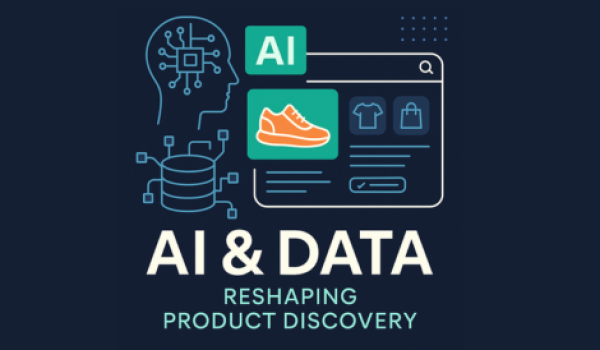
AI and Data in Product Discovery: Insights from ELN and Akeneo Webinar
In a rapidly evolving commerce environment, the way consumers find and purchase products is shifting. In the recent ELN × Akeneo webinar, the discussion centred on how artificial intelligence (AI) and highquality product data are redefining product discovery. The experts explored how companies must move beyond traditional keywordbased search, how shopper intent and context are becoming more important, and what organisations need to prioritise to remain competitive.
Speakers
- PJ Utsi, Chief Creative Officer, Vaimo
- Justin Thomas, VP Sales EMEA North, Akeneo
- Peter Dorrington, Host and Moderator, Executive Leaders Network
The Evolution from Search to Find
The world of product discovery is undergoing a major shift. Traditional SEO techniques, which rely on keywords and static descriptions, are no longer fit for purpose in an environment where consumer behaviour is shaped by AI tools, conversational interfaces and context-driven decision-making.
Consumers no longer simply search; they expect to find. That shift, subtle but significant, changes everything from how product data is structured to how brands ensure discoverability and relevance. The move from keyword-based search to intent-based discovery calls for smarter data management and AI readiness.
Why Traditional Product Search Is Struggling
In the past, product discovery hinged on consumers typing precise keywords into search engines or ecommerce site search bars. But people describe the same product in vastly different ways. Language, personal context and even emotional intent all influence how someone frames a search.
Traditional systems are not equipped to interpret such nuance. They rely on exact matches, static attributes and linear filters. As a result, the chances of misalignment between what a shopper wants and what a site serves up are high. Worse, this misalignment creates a frustrating experience, increasing bounce rates and reducing conversion.
The Role of AI in Improving Product Discovery
AI opens up new possibilities. By analysing vast volumes of product data, customer reviews, behaviour patterns and even environmental context, AI tools can present personalised, relevant product recommendations that reflect actual intent rather than keyword proximity.
Some of the practical improvements include:
- Interpreting product-related conversations in natural language
- Understanding complex combinations of features, use cases and constraints
- Leveraging customer feedback to improve data accuracy and product descriptions
- Surfacing products based on actual outcomes rather than rigid filters
The shift to AI-powered discovery marks a transformation from product search based on catalogues to guided finding based on relevance and suitability.
Five Steps to Prepare Your Data for AI Discovery
To make AI work in product discovery, the foundation must be strong. Clean, structured, centralised data is critical. Without this, AI will produce irrelevant or incorrect results, leading to lost sales and poor customer experiences. The five essential steps are:
- Audit Your Existing Data
Identify gaps, inconsistencies and duplicates. Determine how well your data aligns with the language and expectations of your customers. - Standardise Your Attributes
Ensure product information uses consistent language and formatting. For example, colour attributes should not vary between “navy,” “dark blue” and “hex codes”. - Centralise Product Information
Use a PIM (Product Information Management) solution to establish a single source of truth. This ensures accuracy across channels and markets. - Train Teams Across Functions
Make data quality a shared responsibility. Marketing, sales, product and ecommerce teams all need to understand how their input affects discoverability. - Establish Governance and Continuous Maintenance
Data consistency is not a one-time project. Create processes and roles to ensure data remains accurate, relevant and AI-ready as product ranges and customer expectations evolve.
The Commercial Impact of AI-Driven Product Discovery
Businesses that get AI discovery right see clear commercial benefits. Not only do they improve product findability and conversion, but they also reduce costly returns, as shoppers receive products that better match their needs.
Additionally, by analysing customer reviews and support interactions, companies can identify new use cases, underserved segments and opportunities for cross-selling or upselling. This level of insight was previously unavailable or difficult to scale.
Examples include:
- AI surfacing waterproof running shoes based on weather, terrain and size preference
- In-store sales tools offering product recommendations based on margin, availability and customer needs
- AI assistants interpreting review content to optimise product listings with language that reflects actual user sentiment
These are no longer future possibilities. They are active, real-world applications already in market.
Q&A
Question: What is a key indicator that product data is not ready for AI discovery?
Answer: If AI tools cannot accurately describe or locate your product, your data likely lacks structure, consistency or availability in crawlable formats.
Question: How can retailers determine whether poor product visibility is due to data issues or discovery strategy?
Answer: Use AI audit tools to simulate product searches. If your product does not appear or ranks poorly despite correct listing, it may be a data issue. If it appears but underperforms, it may be a strategy issue.
Question: What is the first step to prepare product data for AI-driven commerce?
Answer: Conduct a data audit to identify missing attributes, inconsistent labelling, or misaligned taxonomy across your product catalogue.
Question: How can a business make a case for investing in data quality and AI readiness?
Answer: Quantify the costs of product returns, missed sales and customer service cases linked to poor data. Show how improved data reduces these costs and improves conversions.
Question: What is a safe way to start using AI in ecommerce without overcommitting?
Answer: Start with targeted use cases such as product attribute standardisation or review sentiment analysis. Avoid wide-scale AI deployment until foundational data is reliable.
Question: Will traditional ecommerce site search become irrelevant with AI?
Answer: No. Traditional site search remains useful for known-item purchases. AI-powered discovery complements it by improving intent-driven and exploratory journeys.
Question: What tools help brands identify if products are missing from AI search results?
Answer: Use PIM-integrated tools that compare product discoverability against competitors and provide optimisation recommendations based on AI search patterns.
Question: Why does structured product data matter for AI commerce?
Answer: Structured data allows AI to interpret, compare and rank products accurately. Inconsistent or unstructured data leads to incorrect recommendations and poor user experience.
Question: How can feedback and reviews improve product discovery?
Answer: AI can analyse customer feedback to identify frequently mentioned attributes. This informs product descriptions and improves relevance in future search and discovery experiences.
Final Thoughts
Product discovery is no longer a passive process. Shoppers expect relevant results, fast. Whether they are searching via voice, text or conversational interface, the expectation is that retailers understand their intent and context.
Brands that invest in clean, structured data and enable AI-driven search will win. Those that rely on outdated keyword strategies and inconsistent catalogues will fade from view.
AI is not the magic solution. It is an amplifier. With the right data and governance in place, it can transform discovery and drive results. Without it, AI will only make existing problems more visible.
To watch the full webinar on-demand and explore these ideas in more depth, visit: Webinar | The Next Chapter of Commerce
#AICommerce #ProductDiscovery #eCommerceData #PIM #RetailTechnology #IntentDrivenSearch #CustomerExperience #DigitalTransformation #Akeneo #Vaimo
Recent Articles
How Darktrace detects low and slow cyber-attacks
Flying under the radar: How Darktrace detects ‘low…
Are you using these 3 GDPR training tactics?
Six months on from the deadline for organisations to…
Gartner: Privileged Access Management
A recent report from Gartner reveals the top IT Security…
Your 60 day GDPR plan
The General Data Protection Regulation (GDPR) hasn’t…
Data privacy in the wake of Facebook and Cambridge Analytics
Facebook and Cambridge Analytics are dominating headlines…
Artificial Intelligence and the problem with privacy
This blog post discusses how the General Data Protection…
GDPR is coming: Don't forget the basics. 5 ways to keep it simple.
If we are experts in Change then we need to live and…